

Chinese Electric Cars: What Buyers Should Know
Chinese Electric Cars: What Buyers Should Know
Chinese electric cars in the UAE have gone from a niche curiosity to a genuine part of the mainstream market in a few short years. Brands that most buyers hadn't heard of a decade ago now sit on the same shortlists as long-established Japanese and Korean names. iCAUR is part of that same shift, as the UAE arm of OMODA & JAECOO under China's Chery Group, though it takes a different technical approach with REEV rather than a pure EV lineup. This article covers what's actually worth knowing before buying any Chinese electric car here, not just the marketing behind it.
Why Chinese Electric Cars Have Grown So Fast
China builds a large share of the world's EV batteries and components, which gives its automakers a genuine cost and scale advantage rather than just an aggressive pricing strategy. That scale has also meant faster iteration: new models and updated tech tend to reach the market quicker than the multi-year cycles typical of legacy automakers. The result in the UAE has been a wave of electric and electrified options that undercut equivalent Japanese, Korean and European models on price while matching or exceeding them on features like large touchscreens, driver-assistance systems and fast charging.
The timing has also lined up well with the UAE's own push toward electrified transport, which has made dealers and buyers more open to new brands entering the market than they might have been a decade ago.
Are Chinese Electric Cars Reliable? What Buyers Actually Ask
This is the question behind most of the hesitation, and it's a fair one to ask rather than dismiss. A few honest points worth knowing:
• Quality has moved quickly, but unevenly. Some Chinese brands have invested heavily in build quality, safety testing and long-term reliability data. Others are newer to export markets and have a shorter track record to judge by, so it varies brand to brand rather than being a blanket yes or no.
• Gulf-specific testing matters. Reputable brands selling in the UAE typically run their batteries and cooling systems through extended heat testing for Gulf conditions specifically, since UAE summers are genuinely harder on both batteries and air conditioning systems than most markets these cars were originally designed for.
• Battery warranties are usually generous. It's now common for Chinese EV brands to back their batteries with 6 to 8 year warranties, in the same range as or longer than many established competitors.
• Service network maturity varies. Some brands have been established in the UAE for years with a wide dealer footprint, while others are still building theirs out, which affects how easy it is to get parts and servicing down the line.
The Chinese Brands Now Selling Electric Cars in the UAE
Several Chinese groups now have electric or electrified models on UAE roads, each with a different focus:
• BYD, sold as BYD UAE through local dealers, is a dedicated EV and battery specialist, with a lineup spanning the Dolphin, Atto 3, Seal, Song and Tang.
• MG, owned by China's SAIC Motor, has one of the longest-established dealer networks of any Chinese brand here, with the MG4 and MG ZS EV as its main electric models.
• Geely, which also owns Volvo and Polestar globally, has been bringing EV models into the UAE alongside its established petrol lineup.
• GAC, through its Aion sub-brand, is a newer but growing electric presence in the market.
• Chery Group, the parent of Jaecoo, Omoda and iCAUR, covers a wide spread of the market between them, from mainstream SUVs to iCAUR's REEV-specific lineup.
• Jetour, Changan and Haval round out the wider Chinese presence in the UAE, currently more focused on hybrid and petrol models with electrified options expanding over time.
None of these brands are identical in approach, warranty terms or how long they've been established here, which is exactly why it's worth checking the specifics of any one of them rather than treating “Chinese EV” as a single category.
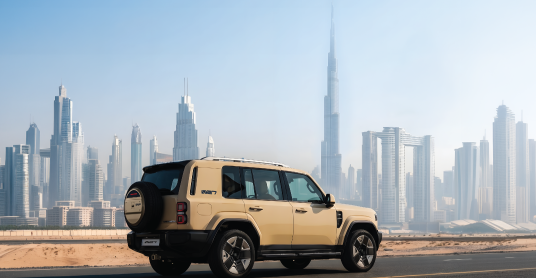
iCAUR's position within that group is worth a closer look on its own terms. Chery has been China's largest passenger-vehicle exporter for over two decades running, and OMODA & JAECOO, the brand family iCAUR sits alongside under Chery, passed one million cumulative global sales within around three years of its 2023 launch, the fastest a new automotive brand family has reached that mark, while picking up international recognition along the way for safety, technology and design. That scale is what funds the R&D, crash testing and export infrastructure iCAUR draws on in the UAE. Where it specifically differs from most of its Chinese siblings is focus: rather than adding REEV as one variant within a broader petrol or EV range, iCAUR's entire UAE lineup, the V27 and 03T, is built around that architecture specifically, rather than as an add-on.
How Chinese EVs Generally Compare on Price
Without pinning down exact figures, since pricing shifts often and varies by trim and dealer offer, the pattern holds fairly consistently: Chinese electric and electrified models tend to undercut equivalent Japanese, Korean and European alternatives at a similar spec level. That gap is often what draws first-time EV buyers toward a Chinese brand in the first place, though it's worth weighing against the service network and resale points above rather than treating price alone as the deciding factor.
What to Check Before Buying Any Chinese Electric Car
A few practical checks apply regardless of which brand you're considering:
• Is it an official import? Buying through an authorized local distributor generally means a proper warranty and access to genuine parts, compared with a grey-market import that may carry neither.
• What does the battery warranty actually cover? Look at the years, kilometre limit, and what counts as degradation, since terms differ meaningfully between brands.
• How mature is the service network? A wider dealer footprint generally means easier servicing and better parts availability a few years down the line.
• What does resale look like? Resale data for newer Chinese EV brands in the UAE is still developing compared with long-established Japanese and Korean models, so it's worth checking current used listings rather than assuming.
• Does the model fit UAE conditions specifically? Ask whether the battery and cooling system have been tested or tuned for Gulf heat, rather than assuming a global spec is identical to what's sold here.
Where REEV Fits Into This Shift
Alongside pure EVs, several Chinese-linked groups are also bringing REEV, or range-extended electric vehicle, technology into the region, treating it as a practical bridge for buyers who want electric driving without full dependence on charging infrastructure. The idea has picked up specifically because it addresses a real UAE concern: public charging coverage is still growing rather than dense outside the main cities, and REEV removes the dependency on it entirely by using a small petrol engine purely as an onboard generator. iCAUR, under the Chery Group umbrella, has built its entire UAE lineup, the V27and 03T, specifically around this architecture rather than offering it as one variant among several.
Making Sense of the Options
The honest answer to “should I buy a Chinese electric car” depends far more on the specific brand, model and warranty terms than on the fact that it's Chinese at all. Some are excellent value with strong backing, others are still proving themselves in this market, and the difference usually comes down to homework rather than badge. If REEV specifically is something you'd like to understand better, or see in person, you can explore ICAUR's REEV lineup or book a test drive.